
Lisbon Environment, Territory & Culture
Workshop at Palácio Belmonte, Lisboa
Alfama District
Lisbon, 14 May 2012
The memories we carry from the landscapes of our childhood, natural landscapes, city streets, smells, colours, shapes, and sounds, are never only individual. They belong to a collective experience, shared across generations and quietly inscribed in our cultural memory.
There exists a profound relationship between lines and shapes, colours and sounds, and the human psyche. What we see, inhabit, and move through each day influences how we feel, how we think, and how we understand the world around us. Every form we encounter is the result of opposing forces brought into balance, and every visible structure carries the trace of the energies that shaped it. In this sense, the built and natural environments are not neutral, they participate in shaping our inner life.
History has long recognised this connection between image and human perception. In the ninth century, after the long theological dispute with the Eastern Orthodox iconoclasts, the Church of Rome ultimately acknowledged, in the year 843, that images hold within them a fragment of living energy. This idea suggests that forms, colours, and compositions are not merely decorative, they carry meaning and influence the way we perceive reality.
When landscapes, whether natural or urban, are preserved and understood as masterpieces of collective creation, they invite us to look at the world with renewed attention. They awaken a different way of seeing, one that recognises the deep dialogue between place and human spirit.
Alfama embodies this relationship in a remarkable way. Its narrow streets, layered history, and vibrant daily life create a landscape that is authentic, unique, and joyful. It is a place shaped by centuries of human presence, where memory, architecture, and community continue to coexist.
For this reason, Alfama must be preserved, just as so many generations before us have carefully protected it. Safeguarding such places is not only an act of heritage conservation, it is a collective responsibility towards the cultural and emotional landscapes that shape who we are.
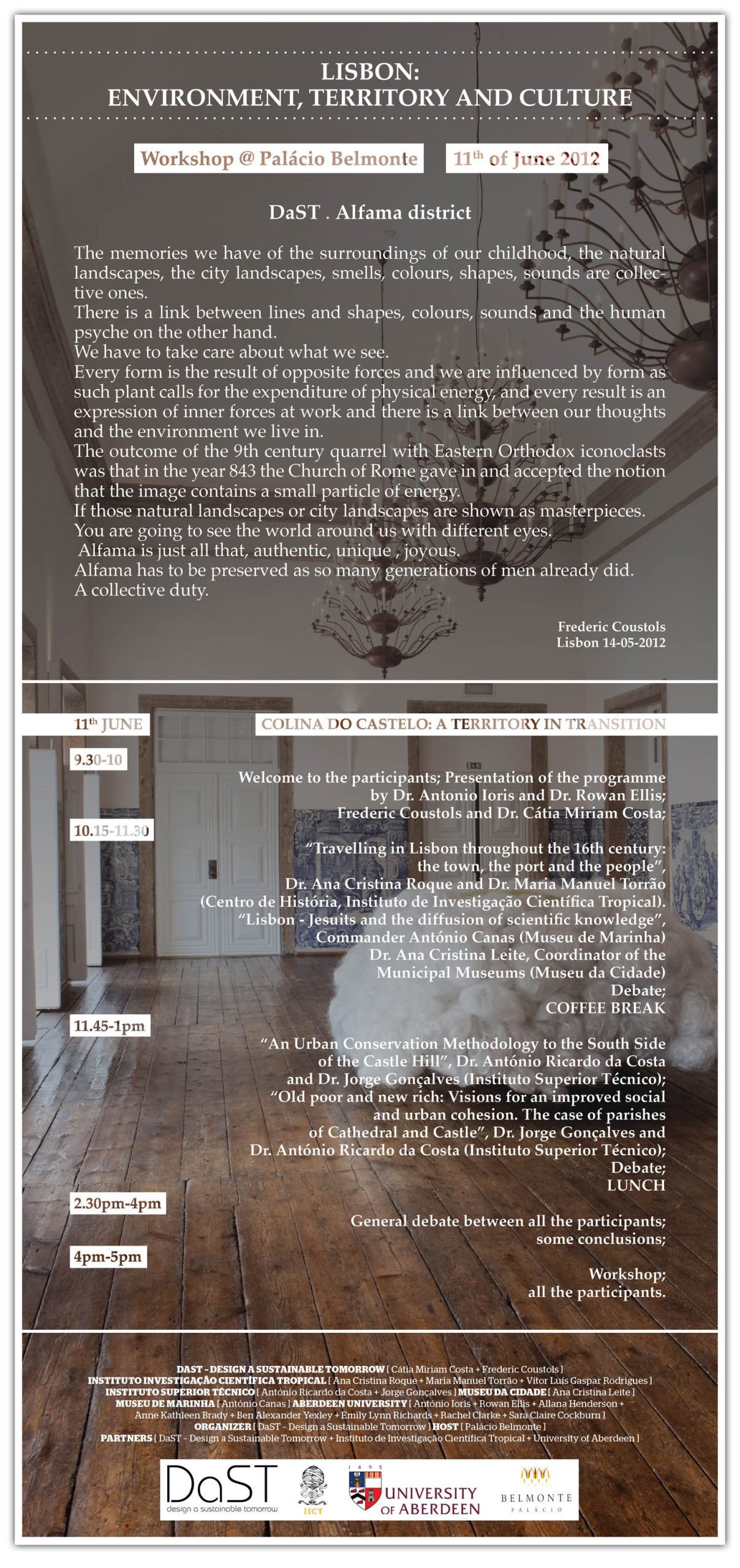
programme
11th June
09:30-10:00
Welcome to the participants; Presentation of the programme by Dr. Antonio Ioris and Dr. Rowan Ellis; Dr. Frederic Coustols and Dr. Cátia Miriam Costa;
10:15-11:30
“Travelling in Lisbon throughout the 16th century: the town, the port and the people”, Dr. Ana Cristina Roque and Dr. Maria Manuel Torrão (Centro de História, Instituto de Investigação Científica Tropical).
“Lisbon – Jesuits and the diffusion of scientific knowledge”, Commander António Canas (Museu de Marinha)“, Dr. Ana Cristina Leite, Coordinator of the Municipal Museums (Museu da Cidade)
Debate followed by Coffee Break
11:45-13:00
“An Urban Conservation Methodology to the South Side of the Castle Hill”, Dr. António Ricardo da Costa and Dr. Jorge Gonçalves (Instituto Superior Técnico);
“Old poor and new rich : Visions for an improved social and urban cohesion. The case of parishes of Cathedral and Castle”, Dr. Jorge Gonçalves and Dr. António Ricardo da Costa (Instituto Superior Técnico)
Debate followed by Lunch
14:30pm-16:00
General debate between all the participants; some conclusions;
16:00-17:00
Workshop with all the participants
technical file
DaST – Design a Sustainable tomorrow:
Cátia Miriam Costa
Frederic Coustols
Instituto Investigação Científica Tropical:
Ana Cristina Roque
Maria Manuel Torrão
Vítor Luís Gaspar Rodrigues
Instituto Superior Técnico:
António Ricardo da Costa
Jorge Gonçalves
Museu da Cidade:
Ana Cristina Leite
Museu de Marinha:
António Canas
Aberdeen University:
António Ioris
Rowan Ellis
Allana Henderson
Anne Kathleen Brady
Ben Alexander Yexley
Emily Lynn Richards
Rachel Clarke
Sara Claire Cockburn
Organizer:
DaST – Design a Sustainable Tomorrow
Host:
Palácio Belmonte
Partners:
DaST – Design a Sustainable Tomorrow
Instituto de Investigação Científica Tropical
University of Aberdeen